by
by 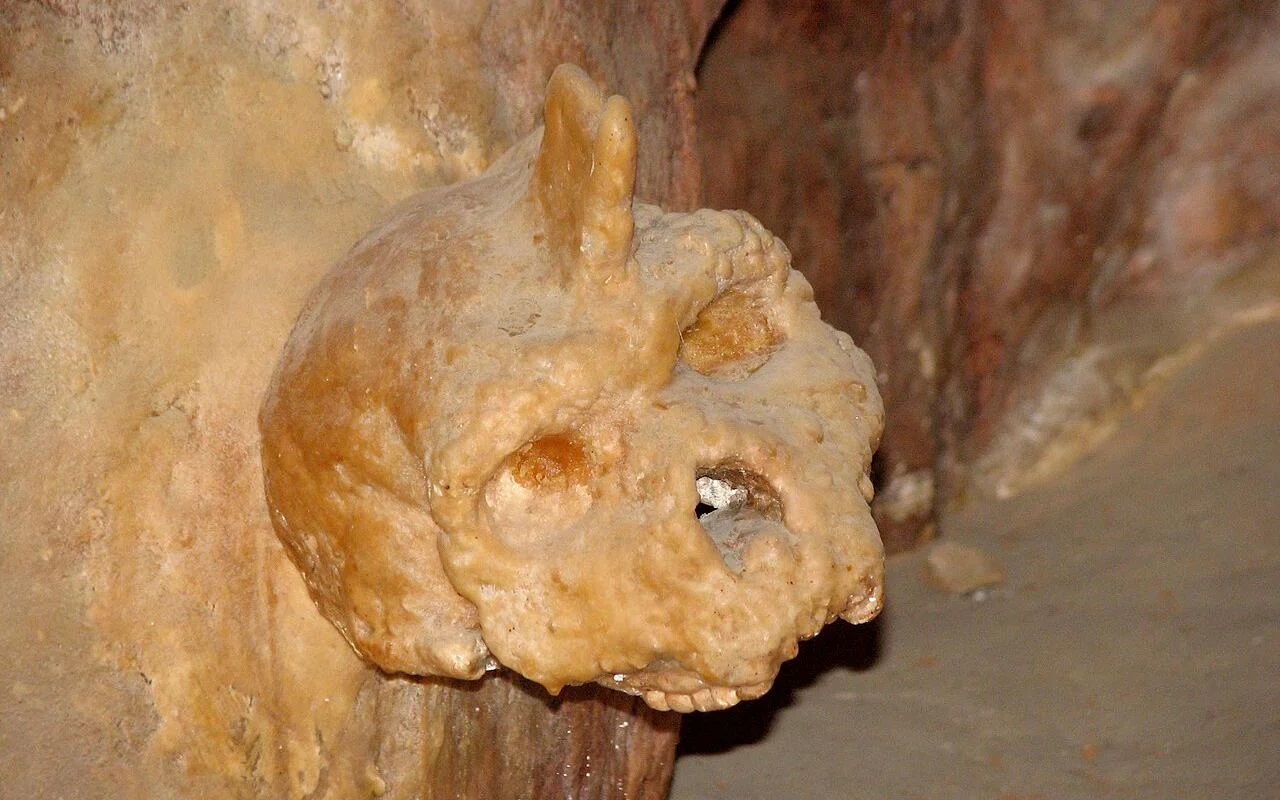
Discovery
In 1959, near the Greek village of Petralona in the Chalkidiki region, a local resident, Christos Sarigiannidis, made a discovery that would challenge established views of human evolution. Deep inside Petralona Cave, he found a fossilized skull embedded in a solid mass of calcified rock.
The skull was so firmly trapped that scientists spent several years carrying out careful and delicate work before it could be safely extracted for study.
Age and Dating Controversies
Initial studies estimated the age of the Petralona skull at around 200,000–300,000 years. However, later claims suggested it could be as old as 700,000 years, sparking intense scientific debate.
Modern dating methods, including uranium-series analysis and electron spin resonance dating, generally support an age of approximately 300,000 years. This places the skull in a critical evolutionary window — between Homo erectus and Neanderthals.
Who Did the Skull Belong To?
The Petralona skull continues to puzzle scientists due to its unusual mix of primitive and modern features:
- Massive brow ridges reminiscent of Homo erectus
- A cranial capacity of about 1200 cm³, close to early Homo sapiens
- Facial bone structure that differs significantly from classic Neanderthals
Because of this unique anatomical combination, some researchers proposed that the skull may represent an entirely separate branch of human development. It has even been informally labeled Archanthropus europaeus petraloniensis — a hypothetical ancient European human type that may have lived alongside early Neanderthals.
Ongoing Scientific Debate
To this day, scientific opinion remains divided:
- Mainstream view: The skull likely represents an early form of Homo heidelbergensis, a transitional species believed to have given rise to both Neanderthals and modern humans.
- Alternative Greek research: Some scientists argue that the Petralona individual belonged to an unknown hominin population that evolved independently in Europe, long before modern humans arrived from Africa.
Political tensions, restricted access to the fossil in earlier decades, and disagreements over dating methods have only fueled the controversy.
Why the Petralona Skull Matters
If the alternative theory proved correct, the implications would be profound. It would mean that multiple intelligent human-like species once coexisted in Europe, not just our direct ancestors and Neanderthals. Such a discovery would dramatically reshape our understanding of migration, adaptation, and human diversity in prehistoric Europe.
Rather than a simple, linear evolutionary chain, the Petralona skull hints at a complex web of parallel human lineages, some of which may have vanished without leaving many traces behind.
A Fossil That Still Defies Easy Answers
More than six decades after its discovery, the Petralona skull remains one of Europe’s most enigmatic prehistoric finds. It stands at the crossroads of evolution — neither fully primitive nor fully modern — and continues to challenge scientists to rethink what it truly means to be human.