by
by 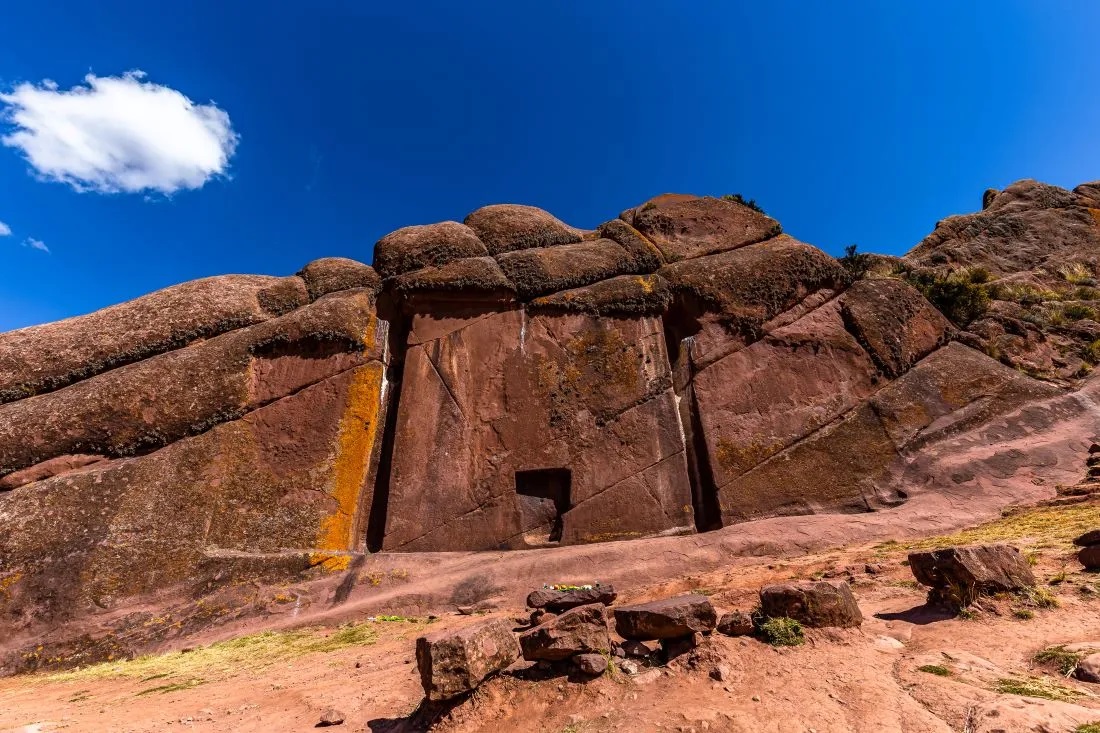
Aramu Muru, also known as Hayu Marca or the “Gate of the Gods,” is one of the most enigmatic stone structures in South America. It is located in southern Peru, near Lake Titicaca, a region long associated with Inca, pre-Inca, and ancient Andean cosmology. The structure carved into solid rock appears too precise and symbolically charged to be dismissed as a natural formation, yet at the same time it does not fit into any known architectural category.
What Exactly Is Aramu Muru?
Aramu Muru is a massive rock face approximately 7 meters high and 7 meters wide, featuring a perfectly symmetrical T-shaped niche carved into its center. Within this niche lies a smaller recess, resembling a socket designed to hold a stone disk or another object. The surrounding rock surface is smoothly worked, with straight, deliberate lines that clearly indicate intentional stone processing rather than natural erosion.
Importantly, this structure is not a cave entrance, not a doorway, not a tomb, and not a temple in the classical sense.
Archaeological Context
Mainstream archaeology classifies Aramu Muru as a ritual site, possibly linked to pre-Inca cultures. However, this interpretation remains uncertain because:
- no inscriptions have been found,
- no artifacts clearly defining its function have been discovered,
- no historical records describe its ritual use in everyday practices.
As a result, Aramu Muru remains an anomaly even within academic frameworks.
The Legend of Aramu Muru
According to Andean oral tradition, a priest named Aramu Muru fled to this site during the Spanish conquest, carrying a sacred golden disk. The legend states that he placed the disk into the central recess of the rock, activated the gateway, and disappeared into another world—never to return.
This story is one of the main reasons the site is referred to as the “Gate of the Gods.”
Alternative Interpretations
Researchers of alternative history propose that Aramu Muru may have been:
- a symbolic or literal gateway between worlds,
- an energetic portal connected to Earth cycles and cosmic forces,
- a technological relic of a lost civilization, operating beyond modern scientific understanding.
It is crucial to emphasize that these interpretations are not proven. They persist largely because no definitive official explanation exists.
Geometry and Symbolism
The structure resembles a stylized doorway that leads nowhere. Similar “false entrances” appear in other ancient cultures, often representing a boundary between the physical and symbolic realms. The central niche is frequently interpreted as a focal point for ritual concentration or resonance, rather than a functional architectural element.
Why Aramu Muru Matters
Aramu Muru is significant because:
- it is a real, physically documented site,
- it demonstrates high precision in stone carving,
- it does not fit into any established architectural or cultural category,
- it exists within a region known for extremely ancient spiritual traditions.
Rather than demanding belief, Aramu Muru raises a deeper question: how much of the ancient world do we truly understand?
Aramu Muru is not proof of the supernatural, but it is evidence of the limitations of our historical knowledge. It stands between science and myth, between stone and symbol. Until new data emerges, Aramu Muru remains a silent gate—one that opens neither with keys nor with theories.
Not everything carved in stone was meant to be opened.