by
by 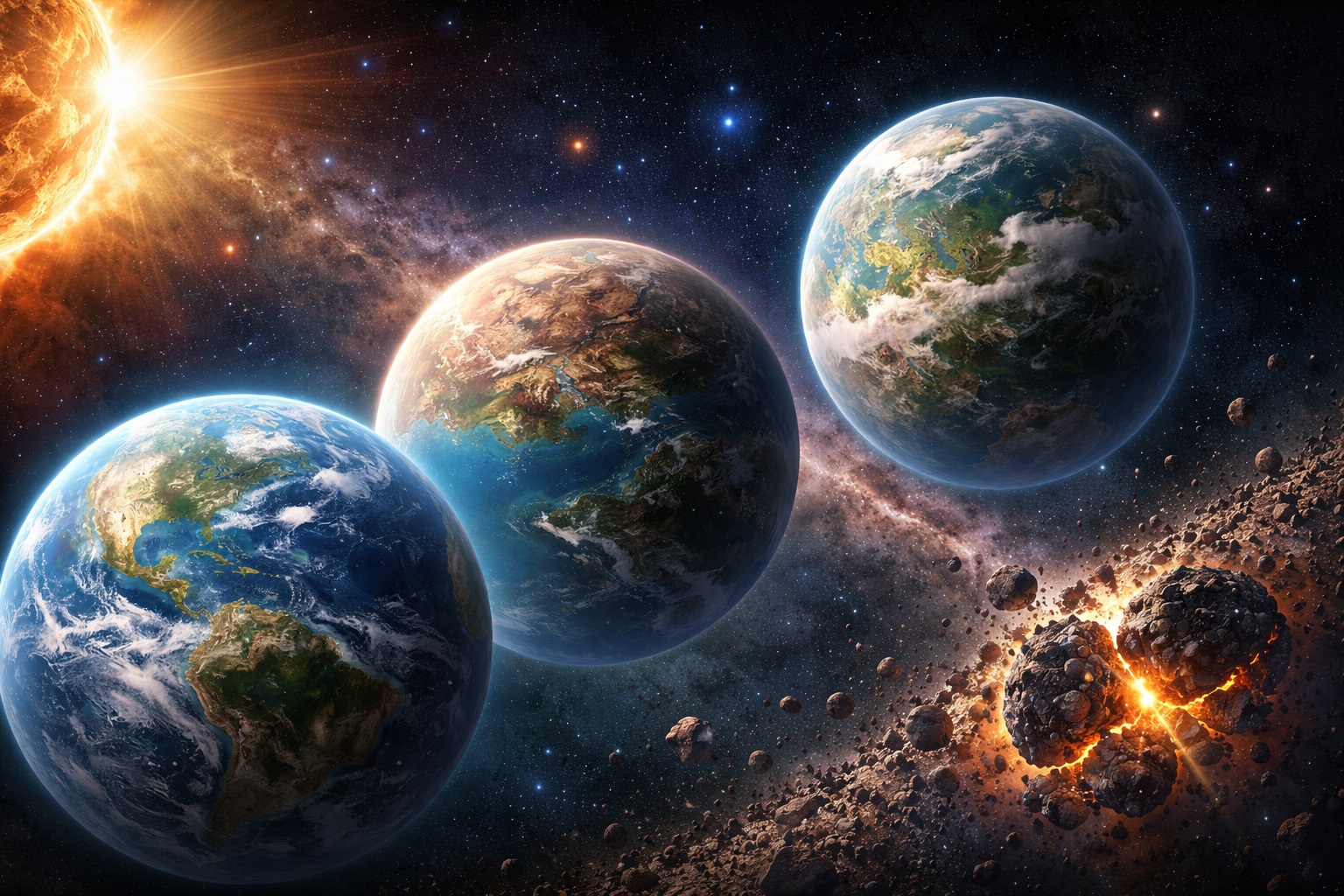
The idea that the Solar System may once have contained more habitable planets than it does today is supported by modern scientific discoveries and long-standing discussions about planetary evolution. At present, Earth is the only known inhabited planet. However, research suggests that both Mars and Venus were once significantly more suitable for life. Some hypotheses also propose the existence of an additional lost planet that no longer exists.
This article examines the scientific evidence, the main theories, and the broader implications of planetary habitability in our Solar System.
What Makes a Planet Habitable
A habitable planet does not necessarily mean one inhabited by intelligent beings. In scientific terms, habitability refers to conditions that allow liquid water to exist for long periods of time. These conditions typically include a stable temperature range, a sufficiently thick atmosphere, and protection from harmful solar radiation, often provided by a magnetic field.
Such environmental stability creates the possibility for life, at least at the microbial level.
Mars: From Water World to Frozen Desert
Scientific evidence strongly indicates that ancient Mars was very different from the planet we see today. Geological formations reveal the presence of river valleys, lake basins, and possibly even vast oceans. Mars once had a thicker atmosphere and a warmer climate capable of sustaining liquid water on its surface.
Over time, Mars lost its global magnetic field. Without magnetic protection, solar wind gradually stripped away much of its atmosphere. As atmospheric pressure decreased, temperatures dropped, and surface water either evaporated, froze, or became trapped beneath the surface. Today, Mars is a cold and dry world with limited potential for surface habitability.
Venus: Earth’s Twin That Took a Different Path
Venus is similar to Earth in size and mass, which has led scientists to refer to it as Earth’s twin. There is growing evidence that early Venus may have had oceans and a more temperate climate.
However, Venus experienced a runaway greenhouse effect. As temperatures rose, increasing amounts of water vapor entered the atmosphere. Water vapor is itself a powerful greenhouse gas, which intensified the heating process. Eventually, heat became trapped on a massive scale, preventing the planet from cooling.
Today, Venus has an extremely dense atmosphere, extreme surface temperatures, and crushing atmospheric pressure, making surface life highly unlikely.
Earth: A Balance of Conditions
Earth remains the only planet in the Solar System known to support complex life. Its position within the Sun’s habitable zone allows liquid water to persist. The planet’s magnetic field shields it from solar radiation, and active geological processes help regulate atmospheric composition over long periods.
This delicate balance of distance, atmosphere, magnetic protection, and geological activity has allowed life not only to emerge but to evolve into complex ecosystems.
The Hypothesis of a Lost Planet
Some alternative theories suggest that a now-vanished planet once existed between Mars and Jupiter, in the region currently occupied by the asteroid belt.
One interpretation proposes that the asteroid belt consists of remnants from a destroyed planet. Other, more widely accepted models suggest that a full-sized planet never formed in that region due to Jupiter’s gravitational influence, which disrupted planetary accretion.
While the destroyed-planet hypothesis remains speculative, the structure of the asteroid belt continues to raise questions about the early formation of the Solar System.
Was Life More Common in the Early Solar System
If both Mars and Venus were habitable during certain periods in their histories, it implies that the early Solar System may have been far more favorable to life than it is today. This opens the possibility that life could have emerged in multiple locations.
Current scientific research focuses primarily on past microbial life. More speculative ideas involving advanced civilizations or catastrophic planetary events remain outside mainstream scientific consensus due to a lack of verifiable evidence.
Conclusion
The history of the Solar System demonstrates that planetary environments are not static. Habitability may represent only a temporary phase in a planet’s long-term evolution. Mars and Venus illustrate how dramatically planetary conditions can change over billions of years.
Earth currently represents a rare example of sustained stability. However, planetary history suggests that such stability should not be taken for granted. Understanding past planetary habitability helps us better comprehend both the fragility and the uniqueness of life in our cosmic neighborhood.