by
by 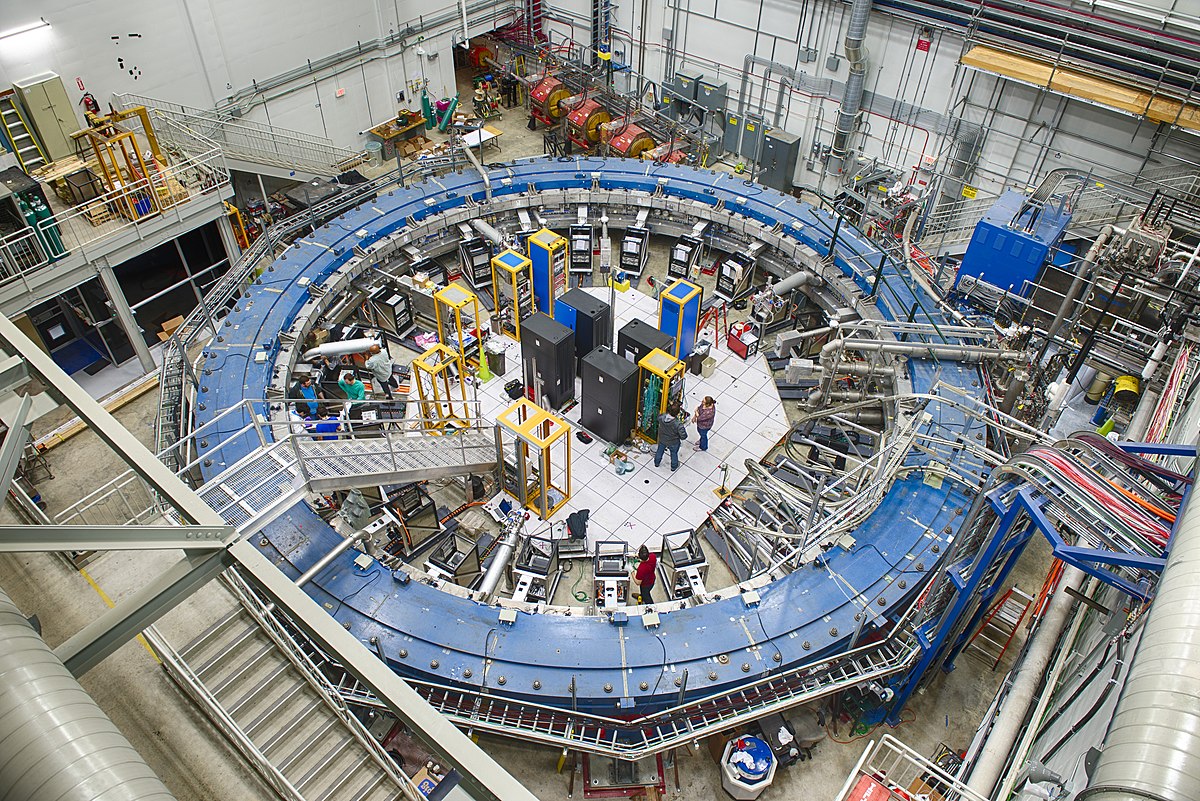
Imagine looking at a compass and noticing that the needle points just a little off from where physics says it should. That tiny misalignment would immediately suggest that some hidden force is at work. This is exactly what scientists are doing with the muon — they are measuring its “magnetic needle” and searching for deviations that might reveal brand-new physics.
What is a muon?
A muon is an elementary particle, very similar to the electron but 207 times heavier. It carries an electric charge, it spins around its axis, and it survives for only two millionths of a second before decaying into lighter particles.
Muons appear naturally when cosmic rays strike Earth’s atmosphere, but in laboratories they can be produced inside particle accelerators.
Why is the muon so important?
Because of its larger mass, the muon is extraordinarily sensitive to subtle quantum effects. Even extremely weak or unknown interactions can leave noticeable traces in its properties.
If the muon behaves differently from what the Standard Model predicts — our current foundational theory of particle physics — it could mean that something entirely new is influencing it.
What does “g-2” mean?
Every charged particle with spin has a magnetic moment. For a perfectly ideal particle, the value of g would be exactly 2.
However, quantum vacuum fluctuations slightly shift this value. This shift is called g-2, and scientists can calculate it with astonishing precision.
If the experimentally measured value does not match the theoretical one, the Standard Model is incomplete — and something unknown is affecting the muon.
Inside the Muon g-2 experiment
The modern Muon g-2 experiment is carried out at Fermilab in the United States (earlier at Brookhaven). At its core is a 14-meter-wide magnetic ring where muons circulate at nearly the speed of light.
As the muons move, their spins wobble in the magnetic field. Scientists measure this wobble with extreme accuracy and use it to determine the muon’s g-2 value.
Results so far
- 2001 (Brookhaven): First strong indication of a deviation from the Standard Model — 3.7σ significance.
- 2021–2023 (Fermilab): High-precision measurements confirmed the discrepancy at 4.2σ significance.
Although the result is not yet at the 5σ threshold required to declare an official scientific discovery, the data strongly suggests that the muon is “misbehaving.” And if it is, then the laws of physics may be hiding something big.
Why Muon g-2 could change science
If the deviation is confirmed, physicists may have to rewrite fundamental theories. This could lead to:
• New forces of nature
Previously unknown interactions that subtly influence particles.
• New particles beyond the Standard Model
Possibly linked to dark matter or other hidden sectors of physics.
• A deeper understanding of the Universe
A shift in how we explain matter, energy, and the structure of reality itself.
A small particle with enormous consequences
Muon g-2 is a rare experiment where a tiny particle may reveal an entire new chapter of physics. The coming years will show whether scientists have simply pushed the Standard Model to its limits — or whether they have opened a door to a completely unexplored world.
If the muon continues to defy expectations, the Universe may be far stranger and richer than we ever imagined.