by
by 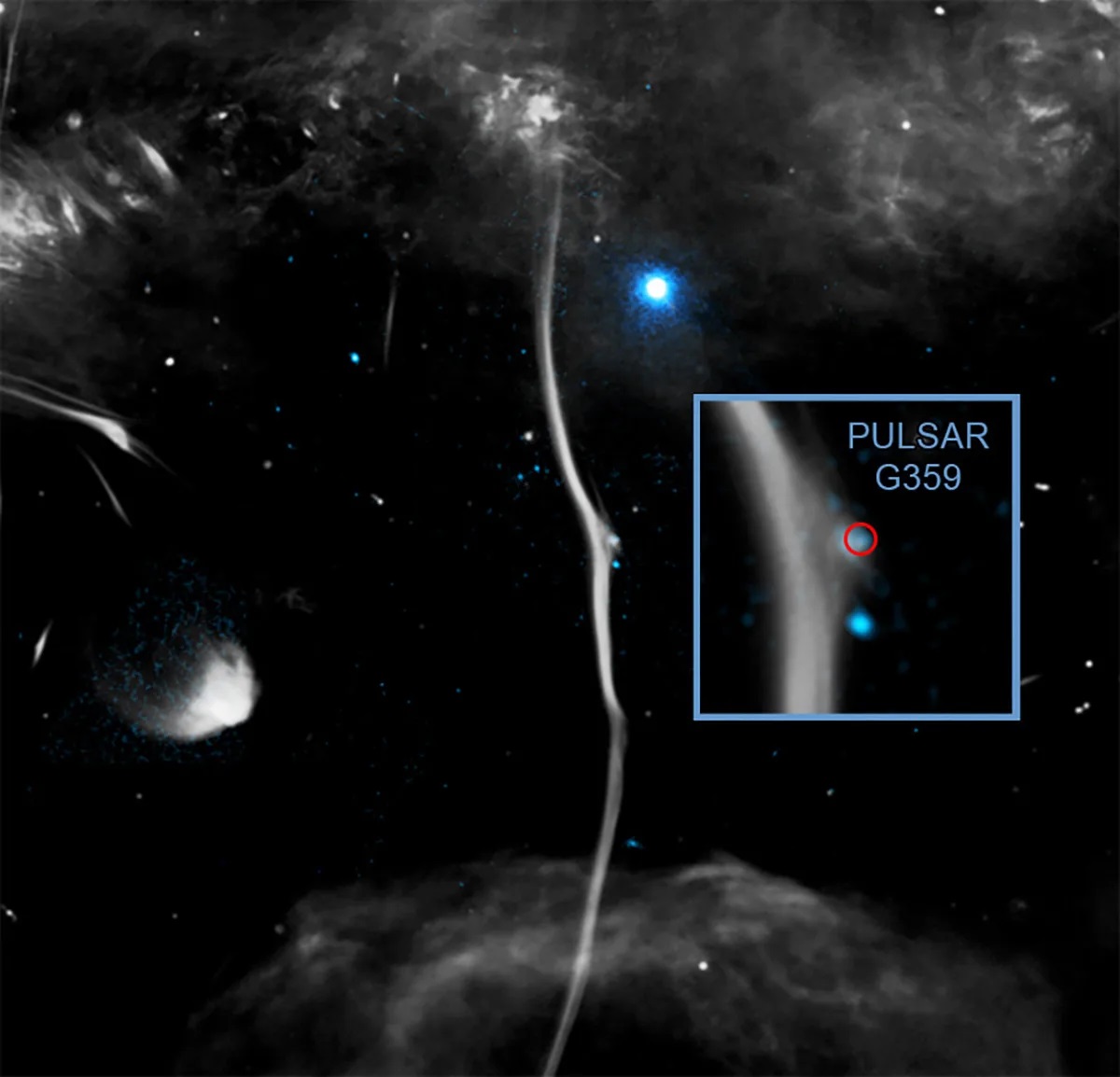
When a Star Turns Into a Cosmic Bullet
After a supernova explosion, a star’s core collapses into a neutron star — an object so dense that a teaspoon of its matter would weigh billions of tons. When this core rotates rapidly and emits rhythmic radio pulses, astronomers call it a pulsar.
If the supernova blast is uneven, the newborn pulsar can be launched through space at extreme speed — over 3 million kilometers per hour. That is the story of G359, a stellar core fired like a bullet through the center of the Milky Way.
Collision With “The Snake”
In the pulsar’s path lay a mysterious structure: a thin, intensely magnetized radio filament known as G359.1–0.2, or simply “The Snake.”
This filament stretches more than 200 light-years, forming a narrow magnetic thread filled with plasma that emits radio waves.
When the pulsar slammed into this structure, a massive energy discharge followed. The magnetic field bent sharply, creating a visible “kink” and triggering bright radio and X-ray emission. Astronomers literally watched the Snake buckle under the impact.
How Scientists Detected It
Using the Chandra X-ray Observatory, along with the MeerKAT and VLA radio telescopes, researchers identified a compact source of radiation exactly at the point where the Snake bends.
This source showed a very steep spectrum (–2.7), a signature typical of pulsars.
Around the impact point they observed diffuse glow — the result of electrons and positrons accelerated during the collision and injected into the filament. Spiraling through the magnetic field, these particles continue to shine thousands of years later.
Lasting Traces of the Impact
The collision’s effects remain visible today.
The point where the pulsar struck the filament still glows in radio and X-rays, as if a cosmic explosion has been frozen in time. Energy continues to flow along the magnetic “cable.”
Meanwhile, the pulsar itself has moved far away and now travels at about 800 km/s, making it one of the fastest known objects in the Milky Way.
Why This Event Is Unique
This is the first observed case of a pulsar directly colliding with a magnetized filament.
The event gives scientists a rare chance to study:
- how magnetic fields break and reform,
- how shockwaves behave in extreme environments,
- how high-energy particles that form cosmic rays are created.
The G359–Snake collision also helps researchers better understand the turbulent region surrounding the supermassive black hole Sagittarius A* at our Galaxy’s center.
Scientific Data
According to 2024 research (Yusef-Zadeh et al., MNRAS 530:254–268), pulsar G359.13142−0.20005 moves at speeds up to 1000 km/s and impacted the Snake, triggering a magnetic shockwave and particle outflow.
X-ray observations indicate the collision occurred roughly 10,000 years ago, yet its signature remains active today.
A Reminder of a Living Universe
G359 shows how the death of a star can ignite new energy across vast stretches of space.
A tiny object only 20 kilometers wide distorted a magnetic structure hundreds of light-years long — proof that the Universe is not calm or static, but alive, dynamic, and filled with forces far beyond human imagination.