by
by 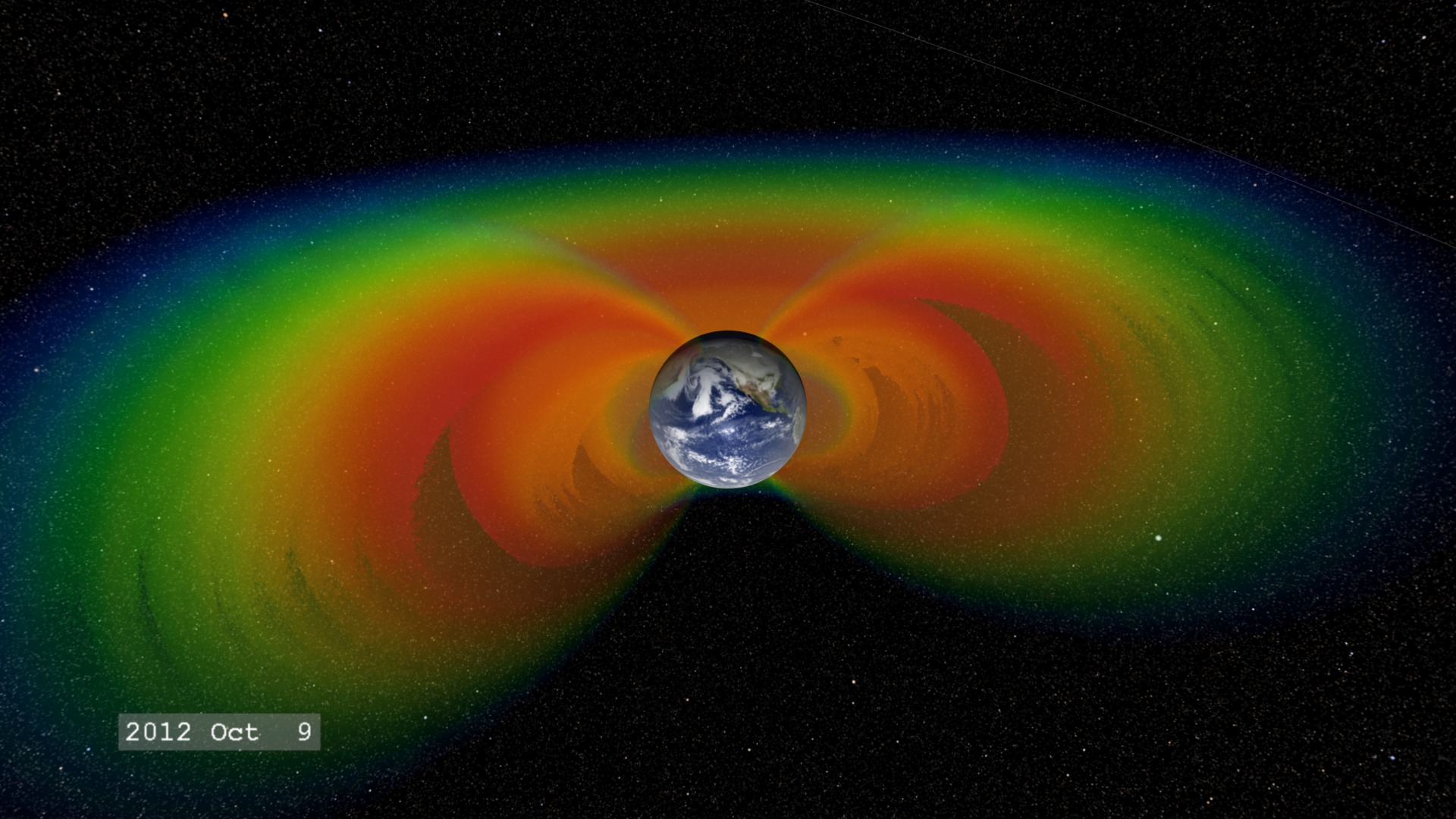
The Van Allen radiation belts are two vast regions of high-energy charged particles that surround Earth. Discovered in 1958 by the American satellite Explorer 1, they transformed our understanding of near-Earth space. The belts revealed that our planet is constantly bombarded by solar wind and cosmic rays, and that Earth’s magnetic field plays a crucial protective role.
How the Belts Form
Earth’s magnetic field behaves like a massive trap. When the solar wind—a continuous flow of electrons and protons from the Sun—reaches Earth, many of these particles become confined along magnetic field lines. They spiral rapidly, bouncing between the poles. Over time, this process creates two major radiation zones that wrap around the planet.
The Two Main Regions
1. Inner Van Allen Belt
- Altitude: ~600–12,000 km
- Dominant particles: High-energy protons
- Characteristics: Extremely intense radiation
- Risks: Hazardous for astronauts and satellite electronics, as proton radiation penetrates deeply and causes long-term damage
2. Outer Van Allen Belt
- Altitude: ~13,000–60,000 km
- Dominant particles: High-energy electrons
- Characteristics: Dynamic and influenced by solar activity
- During solar storms: The belt can expand and intensify, dramatically increasing radiation levels
Why They Matter
The Van Allen belts are not simply a danger zone—they are part of Earth’s protective armor. By absorbing and deflecting incoming radiation, they prevent catastrophic levels of solar and cosmic energy from reaching the lower atmosphere. Without this magnetic shield, biological life and climate systems would be far more vulnerable.
Challenges for Space Exploration
Operating within or crossing these belts requires careful planning:
- Satellites must use radiation-hardened components to survive long exposure.
- Human missions must limit time within the belts to avoid dangerous doses.
- Apollo missions purposely flew fast trajectories through the belts, reducing radiation exposure to safe levels.
- Space weather, especially solar flares and coronal mass ejections, can make the outer belt expand, threatening communications and navigation satellites.
The Van Allen radiation belts demonstrate the deep connection between Earth and the Sun. They are a key layer of planetary defense in space, shaping the environment in which satellites operate and informing how humanity can safely travel beyond Earth. Understanding them is essential—not only for science, but for the future of space exploration.